
I can hear the giggles and groans from the team at the Henry Moore Foundation all the way from England with that blog title! The "King" in question is today's guest blogger James Copper, Sculpture Conservator at the Henry Moore Foundation. He's the second half of the dynamic duo I
mentioned previously: the "relentlessly teasing co-worker" half. But despite being incorrigible, (and endlessly charming and entertaining), how can you not be impressed by a guy who has the energy to oversee the rigging of massive sculptures during the week yet still has the energy for a weekend junket to see Elvis's home, Graceland in the middle of it all? We all enjoyed working and laughing with James so much, and his background in bronze sculpting and fine art handling made him an indespensible resource in planning and installing our show. Here is James's guest blog post:

I have what you might call a great job, one that many covet, but one that was not really for me.
I was born only a few miles from where Henry Moore lived, in a then small ‘market

town’, in the ‘60s. It was the nearest town to where my father’s family was from. Three generations of that family, including my eldest son and I were christened in the parish church in Much Hadham. Little knowing, being only a few weeks old at the time, that the 2 stone heads looking down from the church entrance at me, were by Moore! Nor was I aware that my Godfather, John Farnham, also a sculptor of considerable repute himself, was one of Moore’s assistants.


John (above), who had been at school with my father and was one of his best friends, also lived next door to Moore. As I was growing up I spent a great deal of time with him. He would take me with him visiting museums and galleries, as well as to many collectors’ homes, and to work with him during school holidays. Of course, during my childhood, this was normal; it meant relatively little to me. Whilst with John at work, I had free reign of Moore’s estate, and often used to meet Henry, surrounded by his monumental bronzes, which I used to climb on and slide down! At the time I was more interested in dinosaurs and Romans, I had no idea of the importance of Moore, or his sculpture. If I’d thought about what I was going to be when I grew up, it would have been a vet or something.
On leaving school I joined the Marines, but due to an awkwardly broken leg I had to leave, the military was no longer an option and I was not academic enough to become a vet. The only other thing I had enjoyed at school, and shown any promise in, was art, more specifically drawing and painting. So, to study painting and printmaking at art school it was. Despite having been exposed to sculpture my entire childhood it did not hold my imagination at the time, it was not for me!
During my college years I still spent time with my Godfather, John, and as time went on I began to show an interest in sculpture and to make some of my own. I no longer saw sculpture through a child’s eye, but with maturity and real interest. Unfortunately this interest came too late to see Moore still active on the estate, despite my continued visits to the foundation. I was, however, lucky enough to see him one last time, shortly before his death. He was at John’s home and he no longer knew me, as I had not known who he was when I was a child, but wow!
Moore (below) died while I was still studying, but I can still see his face smiling at me, from the back seat of the car, as I had last seen him.

Following my graduation, from the Kent Institute, I won a bursary, which enabled me to travel to the marble quarries at Quercetta, in Italy, where Moore had worked. On my return to England I managed to gain employment with another friend of John’s friends from the art world, at Momart, as an art technician. Whilst working here I was involved with installations and hangings of many well renowned artists, including Richard Serra, Anthony Caro, Frank Stella, as well as a very large scale show of Moore’s work at the Bagatelle Gardens in Paris. It was during this installation that I was first offered the chance to work for the Foundation, but it took 4 more years for this to come to fruition.
Eventually I was offered a role at the Foundation working alongside my Godfather John, and two other assistants to Moore, Malcolm Woodward and Michel Muller. It was a junior role, and sometimes I had to had to travel to the places the others weren’t keen to go to, or visit again… no matter, it was an opportunity I was not going to miss, what a fantastic job. They had all worked with Henry and they had a wealth of experience between them, I learned a great deal from them, and was able to travel the world.

Malcom Woodward (left) and James Copper (right) at Hoglands, Moore's home, 2007.
As the years passed I became more confident, we became more of a team and I was able to do more of the problem solving. The venues became more worldwide and the challenges became greater, both practically and politically. I was able to be more involved, to do the site visits and the project management of bigger and better shows, and gradually as the time came for the others to retire I have been able to take the reins. This is how I got to be doing one of the best jobs in the world!
I have installed Moore’s work all over the world and each time it is different. That’s what I love, the variety of problems to be solved; how do we install in a bog garden, a pond, a walled garden…? I consider it my job to find the solution, the bigger the challenge, the bigger the buzz and the thrill of solving it and seeing Moore’s work beautifully installed and sited.
The Atlanta Botanical Garden has been a very exciting project to work on, and what a challenge! From our initial site visit, through the installation and finally the many varied openings, the scope of work has never been more demanding and therefore rewarding.

James Copper, Laura Robinson, David Mitchinson at Moore in America grand opening, Atlanta
When we began to think about the show in Georgia there was still one third of the gardens to be completed. We had plans and architectural drawings to work from, but there were areas of woodland still unprepared and buildings still to go up. You have to believe it’s possible!
Several site visits later, following a gruelling schedule to pack the show up in New York and transfer it to Atlanta, we started the installation. Many things had changed on our journey from initial meetings to this point, and we continually adapted our planning to accommodate the works and various issues, which arose, due to changes on-site.
Inevitably there were still problems, which could not have been foreseen or avoided; the weather was stormy, too wet and even, later on, too hot to put the final touches to some of the works, some of our planned access routes had to be changed due to weight restrictions, some due to water and electricity routing, and some of the works were at the absolute weight limit for the size of crane we had available on a particular site. The nature of the works was varied too, meaning some could be lifted directly into their final position, whilst others had to be assembled on site.
As always the problems were solved, the work was gleaming and finished, sitting proudly in situ, as though it had been there forever, and it was time to sit back, enjoy our sense of achievement and party. And what a way to enjoy it; we attended black-tie functions, cocktail parties and even an opening event with sheep… What a job!

I consider myself very privileged to have been to some of the best places in the world, with some of the best works in the world, and to have met some of the very nicest people in the world, particularly at the Atlanta Botanical Garden.
The road-show goes on, and I will be returning to pack up, and say goodbye to Georgia, and it’s great little tree frogs.
I have gone from a small boy who climbed on Moore’s sculptures to being a guardian of them, stopping others from damaging them in any way, but letting them enjoy them in amazing settings.
James Copper, Henry Moore Foundation


 Children provide many different perspectives, questions and observations about Henry Moore’s works. They will see different shapes and figures and want to touch and walk around them. Children can’t wait to tell you their interpretation of a sculpture and then make their very own masterpiece using clay or other natural objects. During my classes and tours, I try to encourage them to see the works from their own perspective. There is no incorrect answer or observation.


 Seated Woman - "Woman riding a buffalo"
 Cardboard boxes, cut open 2-liter bottles and old shirts aren’t your typical gardening tools. However, when bodily harm is at stake you become very creative.
 The garden’s name, Granite Outcrop, is a slight misnomer. The planting concept has changed since its inception 20 years ago. The current Granite Outcrop grows a wider range of plants than traditionally found in southeastern granite outcrops. Wonderfully vase shaped, I call the two enormous Agave americana my gentle giants. They still have spines on the sides and end of each leaf, but they’re so large that I can pet the leaves and feel how soft and velvety they are. Here’s an interesting factoid, do you know the difference between a spine and a thorn? A thorn, like those found on roses, detach without causing the plant harm, but a spine will not cleanly break off and will cause damage.
  When the Henry Moore totems [Upright Motives] were installed they seemed to blend seamlessly into their surroundings. Tall and strong, they picked up the architecture of the plants around them. But, at the same time the fluid lines of the faces emphasize the graceful petals of the often overlooked flowers. Cosmidium burridgeanum, with its deep burgundy petals edged in bright gold looked even more dramatic beside the bronze sculptures. Opuntia, with yellow, peach, and orange blooms shined a little more next to their sculptural counterparts. Leucophyllum frutescens, Barometer Bush’s purple flowers are perfectly balanced by the darkness of the metal. Fuschia Delosperma, cream and orange California poppies, and royal purple Setcreasea, all had a bit more luster.
 This garden can be painful. I’ve shed quite a bit of sweat and blood over the years. But, it is also incredibly rewarding, especially when the three graceful Henry Moore totems persuade guests to look at the Granite Outcrop in a new light.

 Valerie --aka Aquagirl--is the sunniest person we have on staff. She's taught us al
 I love my job.
 When the Henry Moore Foundation sent an advance party to scout the locations best suited to each sculpture, the pool was in it’s glory last year. I had planted vibrant mix of tropicals including Victoria water lilies (Victoria ‘Longwood Hybrid’). The Victorias are the giant water platters.
 At the beginning of this year, the pertinent details of the show were delivered to our department. The Outside Horticulture Department is a team of 12 people. We work together in the spring and fall to plant the colorful displays of annuals, but the rest of the time we tend territories within the garden. This is when I discovered that the ‘Goslar Warrior’ was going to be placed in the Conservatory Pool.
 The plants selected to make this leap work well in both settings. They are also dark and ominous, yet beautiful (just like the sculpture). A large swath of cannas dominate the outer edge of the pool. This group is a mix of Canna ‘Australia’ which has vivacious orange/red flowers, and Canna ‘Intrigue’ sports painterly peach/orange blossoms. The cannas are bordered by black elephant ears (Colocasia esculenta ‘Black Magic’).
 The sculpture appears to levitate on the water thanks to a dark footing beneath. The echo of the fallen warrior’s shield drifts out as the water platters grow and spread. Originally, I had slated a different version of the platters. I ordered seven Victoria cruzianas. These are a species of the platters that has a smaller leaf (up to 4 feet in diameter at maturity) and a higher lip (4-6 inches) and is bright green. As you probably know, not everything works according to plan in gardening. My growers had uncooperative weather this spring and lost the entire crop of this selection. The platters in the pool are my Plan B. In the end, I think they look right with the sculpture.
 The end of the pool beside the Conifer Garden retains the large Umbrella Palm (neither a palm, nor an umbrella; it is Cyperus alternifolius) to balance the heaviness of the opposite end of the display. I’ve also planted Black Marble Elephant Ear (Colocasia esculenta ‘Black Marble’), a division of a favorite lotus (Nelumbo nucifera ‘Shiroman’ which also echoes the shield with it’s round leaves) and my personal favorite—the Mosaic Plant (Ludwigia sedoides).
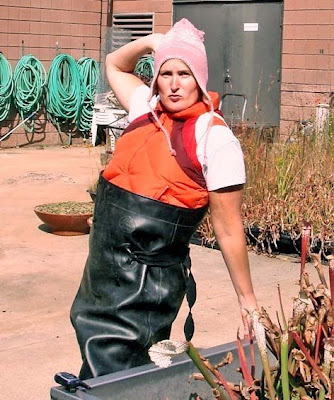 Valerie VanSweden
 In my view, showing up in an internationally distributed, highly regarded magazine such as The Economist makes you a celebrity. So imagine my excitement when the curator of our exhibition, Anita Feldman, received in it a glowing,
  I first met Anita (above on the right) when we traveled to London in 2007 for the opening of
  As Curator, people often ask me how the works were selected and sites chosen. For the Moore show in Atlanta this was a peculiar story. Because the exhibition was already on view at Kew Gardens when we received the request from Atlanta the selections had already been made. So it was not a question of which pieces to bring to the US but how to fit these twenty colossal bronzes initially selected for a much more expansive garden into the formal and more intimate spaces of the Atlanta Botanical Garden. We decided to turn this ‘problem’ into an asset – s

 Knife Edge Two Piece (LH 516) has two dynamic sheer walls of bronze that come together leaving a tense angular gap. It is a sculpture that can withstand the power of an architectural background, (indeed another version of this sculpture stands at the entrance of the east wing of The National Gallery of Art in Washington DC designed by IM Pei) so it was decided to use this piece in the courtyard of the new entrance.


 Using materials on the


 Georgia O’Keefe

 Pablo Picasso
  Giacometti
  Alexander 'Sandy' Calder
  Marc Chagall
  Jean
Jean 

 Vacation Album -- 1931 Irina and I went to the country on holiday with Ben Nicholson and Barbara
 Henry Moore: New pics of the kiddo! Mary's 3 now and learning about shapes 3 p.m., 1946


 Henry Moore: I received a fascinating gift today from Juliette Huxley – the skull of an elephant which I find to be powerful yet gentle at the same time, maybe I will sketch it… (1968)
  Henry Moore: I observed Sheep Piece which looks lovely in the countryside. It commands attention with its sheer presence and size. I saw sheep grazing all around the piece, as if it were as natural as the grass they were eating. “Sculpture on this scale has relationship with living activity and naturally becomes part of the environment.” (1972)


 Posts
Posts


