
 One of the most thilling placements of the Moore exhibition is Oval with Points. P
 ositioned high atop a pedestal, the dark, massive form constrasts powerfully against the city skyline, framing portions of the borrowed landscape inside its central void. The vivid flowers and bizzarre plant forms of the Bog Garden rise up all around it. Most of our visitors have never seen, or even imagined, the colors and shapes of Southeastern pitcher plants and their flowers.
Dr. Jenny Cruse-Sanders, Director of Conservation and Research and this week's guest blog contributor, regularly visits native bog gardens like the one you'll see at the Garden to help develop sustainable habitats. Here's what Dr. Jenny's been up to lately...
 Over the Memorial Day Holiday I took to the road like most Americans for a fieldtrip. I travell
 ed to the panhandle of Florida to meet my colleagues from the Florida Park Service and University of Florida at Torreya State Park, just south of Chattahoochee, Florida. We were planning to conduct two days of field research to track down the critically endangered Florida Torreya (Torreya taxifolia), a coniferous tree (a tree that produces cones, rather than flowers) predicted to be headed for extinction in the next few decades. Through our research we are working to map the additional populations, identify the disease that is killing the trees, and bring additional genotypes into our ex situ (outside of the habitat) collection at the Garden for safe keeping. We hiked through a beautiful stand of forest that is an odd mixture of plants that you might expect to see in the Appalachian Mountains. In these ravines on the eastern side of the Apalachicola River it is not unusual to see a large Tulip poplar (Liriodendron tulipifera) growing right next to a Needle Palm (Rapidophyllum hystrix).
 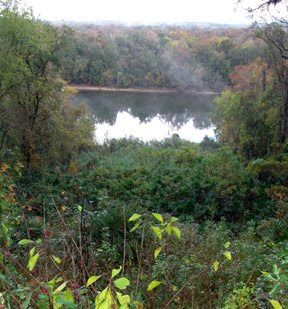 During the trip, I took some time to drive to the Apalachicola National Forest just south of Torreya State Park. This is one of my most favorite places on Earth! Just a few miles south of Bristol, Florida are the large expanses of flat woodlands with a tall canopy of Longleaf Pine (Pinus palustris) and an understory of wiregrass (Aristida sp.) that used to extend across the Southeastern United States. It is deceptively simple in appearance, but it holds one of the most diverse communities of plants in North America. As I approached the forest, I drove slowly, helping several turtles reach their destinations on the eastern side of the road. Heading south along a long flat road in the general direction of the Gulf of Mexico I scanned the grassy woodland and wetlands for the distinctive yellow-green pitchers of the Yellow Pitcher Plant (Sarracenia flava). Once spotted, I sloshed out into the wet ditches in my sandals to peer into pitchers, poke orchid fruits, finger the rough leaves of sunflowers, and photograph the gorgeous sedges in full bloom. These pitcher plant bogs are special places that are nutrient poor, sandy, acidic, and wet from a perched water table in the flat woodlands. The pitcher plants and their companions are only found in areas where these habitat conditions are right. As the sun was setting, I walked back to my car with my notebook, camera and only a few fire ant bites on the bottoms of my feet.
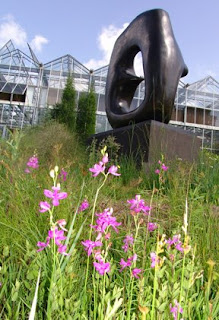 Upon my return to Atlanta, I went to our bog garden to compare the plants in bloom with what I’d seen in the Florida bogs. In the center of the Atlanta Botanical Garden’s bog is Henry Moore’s Oval with Points (1968-70). Massive and also deceptively simple, it rises out of the bog and frames the midtown Atlanta skyline. Moore’s piece was inspired by an elephant skull, native to a habitat vastly different than the one that now hosts this piece. Moore’s piece is huge and seemingly unchanging; it does remind me of the soft rounded forms of an elephant’s torso with two sharp points like tusks in the center. Although the piece appears immutable, its surroundings are ever changing. Day to day the Atlanta skyline is misty, rainy (often this spring), or lit up by the late afternoon sun. The bog below Oval with Points changes weekly and will continue to do so throughout the year.
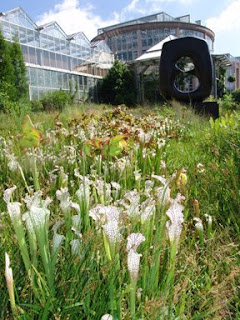 Before the piece was installed we burned our bog (with permission) because pitcher plant bogs are naturally fire maintained. (Click here for a video of the burn: http://www.youtube.com/watch?v=NdaVU8VOKg4&feature=related). The burn mimicked a natural process in pitcher plant bogs and ensured the health of our community of special bog plants. By the time the Oval with Points was installed the bog had already recovered, and pitcherplants, orchids, sedges, and Baptisia had sent up new green shoots. Over the past few weeks, the yellow pitcher plants and white-topped pitcher (Sarracenia oreophila) plants have been putting on a show; first with their large leaves shaped like pitchers to catch insects, and then with their flowers displayed like up-side-down umbrellas. Pitcher plant flowers are uniquely designed to encourage bees carrying pollen to enter one way and allow those same bees carrying new pollen to leave a different way under a petal, therefore promoting cross pollination among flowers. This week the orchid, Tuberose grasspink (Calopogon tuberosus), is lighting up the bog. This sun-loving orchid is terrestrial (rooted in the soil) and native to Georgia.
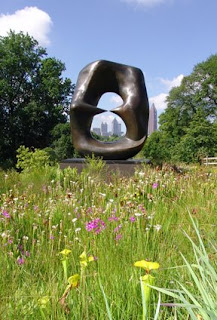 The Atlanta Botanical Garden has recreated the special growing conditions of a pitcher plant bog to display these unusual native plants. The bog around Oval with Points will continue to change in appearance with each new species that develops and blooms over the year. Henry Moore is quoted as saying that “the observation of nature is a crucial part of an artist’s life.” I hope that the Garden visitors will return often to observe Moore’s piece as the native garden around it changes during the exhibit.


 Fine-textured flowers create a white foam lapping at the base of the milky blue and enigmatic Hill Arches. The plants move in the wind, further contrasting with the solidity of the sculpture. At night, the flowers sparkle and appear as if they are stars against the clouds of the Milky Way.
 A field of pink-streaked foliage creates a living carpet on which sits Reclining Mother and Child. Veils of taller pink Spider Flowers (Cleome) form a backdrop veil to frame the piece. It as if the piece is wrapped in living fabrics. I thought pink would be a perfect color to ironically suggest the “femininity” of the piece while also contrasting with the dark patina. Of course, I wanted a brazen shade of pink to emphasize the irony and match the grandeur of Moore’s vision.

 The night experience in the Garden is very near and dear to me. After staffing all but one night of Chihuly nights in 2004, from April through December, it became my personal mission to ensure that all future exhibitions were superbly lit. Not that Chihuly wasn't spectacular at night, it was. However, the Garden simply wasn't designed to be open at night and had minimal ambient lighting, which put a big burden on the limited amount of show lighting to accomplish more that it was designed to do. We learned a lot that year, and Chihuly nights, along with Cocktails in the Garden, created a model for evening events in botanical gardens throughout the United States. Since then, we've added miles and miles of electrical cable and made a substantial investment in theatrical lighting.
  I believe it's paid off. Viewing an exhibition outdoors in the Garden at night is a revelation. The vibrant landscape recedes, freeing the sculptures from the visual competition that exists during the daytime. Shadows and highlights emerge, drawing the eye to details that may otherwise be missed.
  Hill Arches is a great example. With its pale green patina and all white floral planting underneath, this piece practically smiles in the sunshine all day. It's bright and bold and cheerful...if sculpture can be cheerful...just go along with me on this one! At night, it's a completely different picture. It's ghostly, eearie, like it might creep through the bed and over the fence in the dark of night. It seems to be in motion somehow.
 Following Photos and Text by Mary Pat Matheson:
  The turquoise Hill Arches float on a cloud of white
  The urn in the foreground is one of the last remnants of

 This piece really touches me because I know the inspiration behind it. We traveled to Moore’s studio,
  Laura Robinson of
  I felt the need to do something more out of the box in closing. As I walked through the gardens taking photographs, I noticed leaves that had fallen on the pedestals of the pieces in the woodland. Very lovely and serene. The leaves can stay on the pedestals until the next wind comes through because the Garden is not a museum, we don’t try to keep nature tidy. Reclining Figure: Angles is next to the
  We delighted in the sheep at Moore's homestead in England and thought our visitors might as well. Not a baa-d idea!
 The BIG DRAW, a monthly event throughout the exhibition, debuted this weekend. Young and old created chalk masterpieces on the sidewalk, visitors sketched the Moore sculptures and Garden, and artists demonstrated techniques throughout the day. The
 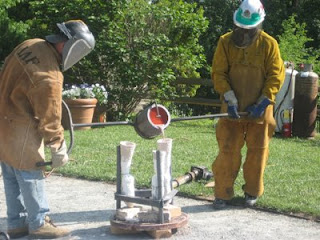 Bronze pouring by
 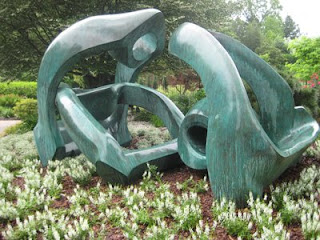 And the rain? Who cares?! It just made the sculptures glisten even more brilliantly...

 James Copper, also from the Foundation, said fully 50% of the work comes after placing the sculpture. Here he cleans Mother and Baby, one of the first pieces visitors encounter in the new Southern Seasons Garden.


 Posts
Posts


